The Jewish Community Simulator
Year after Year,
Amen
Your job is to show up — doing the work in front of you, and standing where the community and the leadership team need you next. Sacred work, and often banal.
Starting just after Sukkot, pick a role and lead a year that's comfortably familiar or blessedly unforgettable.
Play it now Free · no account · works offline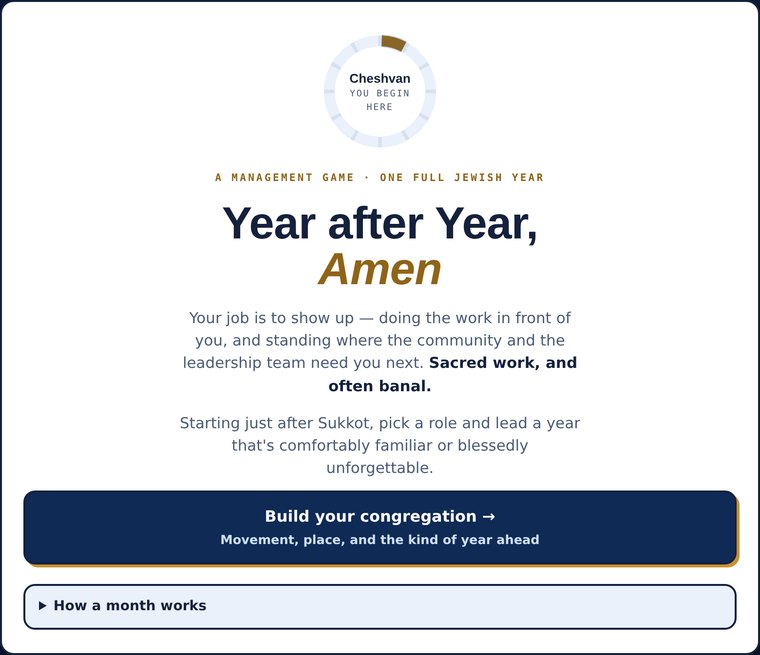
What it is
A management game about the work nobody applauds.
Most games about running things hand you a crisis a minute. This one hands you a Tuesday. You are on staff at a Jewish community organization — one rabbi, one cantor, one education director, one office manager, and a building older than several of you.
The boiler is in here. So are the dues statements, the carpool line, the family that quietly went quiet, and the exact number of lightbulbs the custodian replaced without mentioning it.
How a month works
Four beats, twelve times.
The docket
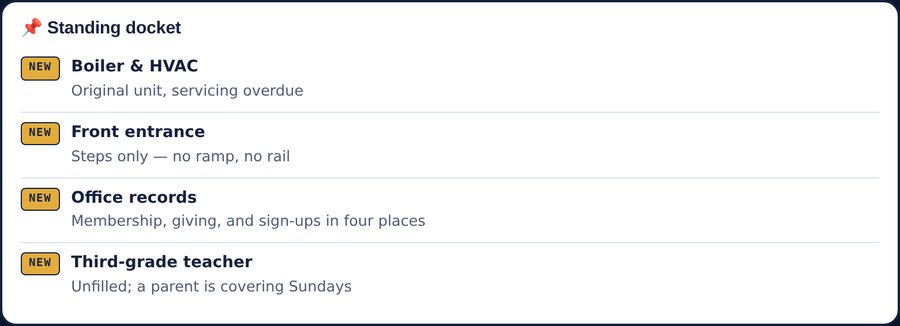
The desk on the first of the month. Standing business, what is open, what has gone overdue — and one line about what your particular desk noticed this morning. Every congregation opens the year with a boiler that is 41 years old and an entrance with no ramp.
The decision
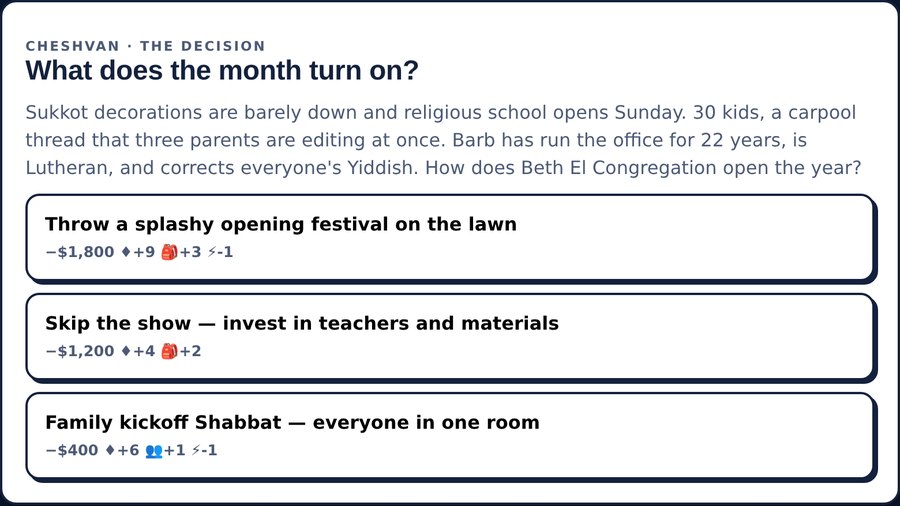
One call the month turns on. Three or four real options with their effects shown before you commit, and dice rolls with the odds printed right on the button. Your role may unlock a gold option nobody else gets.
The work
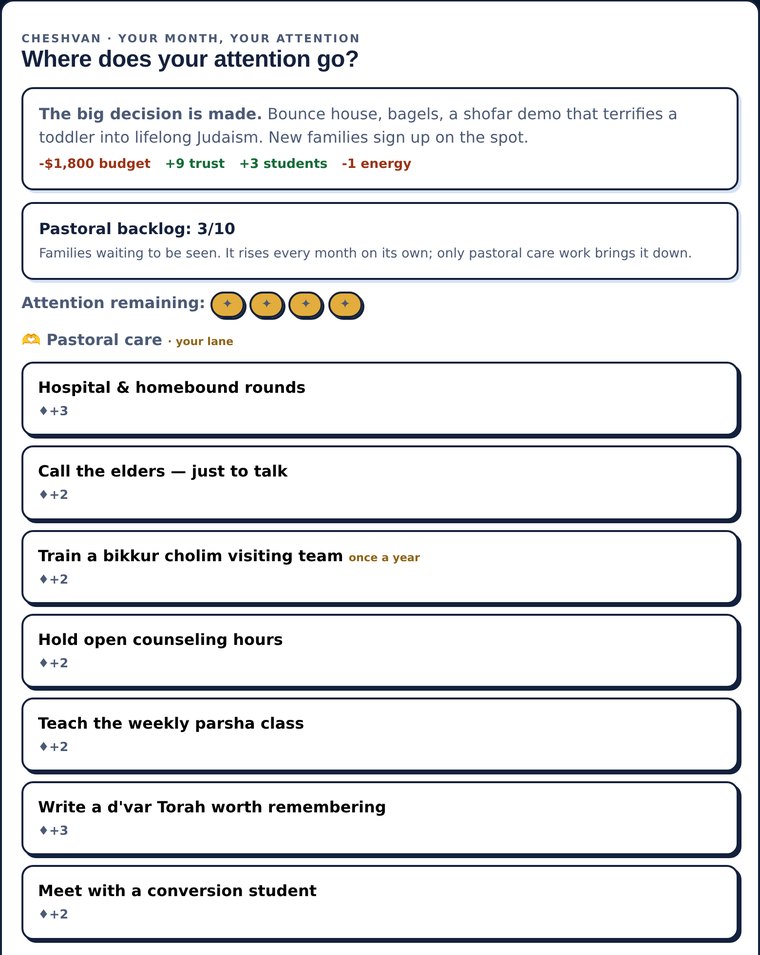
Between two and five units of attention across seven domains — and which work exists depends entirely on your desk. A rabbi does not file grant applications. An office manager does not do hospital rounds.
The report
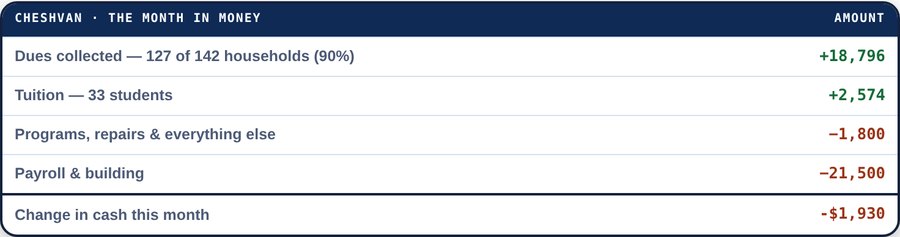
A real income statement every month — dues actually collected, tuition, gifts, spending, payroll — plus what standing cost you in upkeep and where attendance now sits.
The heart of it
Every month ends with the part nothing rewards.
One panel reports what happened regardless of anything you decided. Nothing in it is scored. It is the reason the dramatic months land at all.
· Four Shabbatot held. Typical attendance 61.
· Morning minyan made ten on 19 of 26 days.
· The bulletin went out on the first, as it has since 1935.
· The custodian replaced 11 bulbs and said nothing about it.
Somebody's grandmother asked when the good coffee is coming back. Eternal question, no answer.
A congregation is not the year it had a camel. A congregation is the fact that somebody unlocked the door every single morning for a hundred and thirty-eight years.
192 different congregations
Built before you take a seat.
Four movements
Reform, Conservative, Modern Orthodox, Reconstructionist. Each changes your options, your events, and what the record says about your ordinary week — an eruv checked every Friday, a kitchen under supervision, a values process that takes six weeks and is better for it.
Four places
A 1927 building with no parking. A Sun Belt boomtown inventing everything from scratch. A grand Midwestern congregation where Barb has run the office for 22 years, is Lutheran, and corrects everyone's Yiddish. Or 42 households and a hundred-mile radius.
Three kinds of year
Comfortably familiar. A merger conversation with the shrinking shul across town. Or blessedly unforgettable — a sealed genizah behind the sanctuary wall since 1931, roof bees that become ROOF HONEY 5787, and a camel named Gerald arriving as a vendor's "small substitution question."
Four desks
Each has work only it can do, a lane it is merely adequate outside of, and a private queue nobody else can see. Neglecting your own queue costs more than any single decision on the board.
Then the year tells you what it was
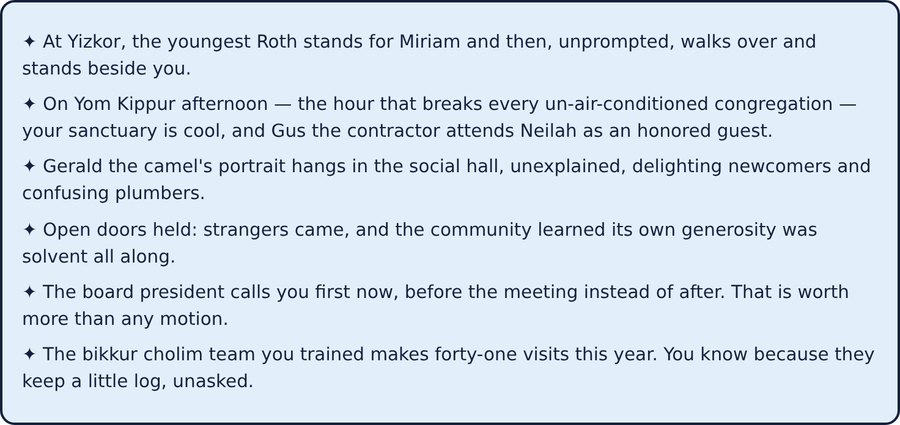
An annual report comparing where the congregation opened to where it closed, and an epilogue composed from your specific choices. The teens you empowered at Shavuot are the ones who read the Akedah at Rosh Hashanah.
Why a Notion company made a game
Because it is the same argument.
Shalom Desk builds Notion workspaces for Jewish community organizations — thirty connected databases across membership, finance, events, education, communications, worship, personnel, and facilities. It exists because the information a congregation runs on is usually scattered across an inbox, a spreadsheet, a clipboard, and somebody's memory, and because the fourth one keeps taking other jobs.
The game is that problem, rendered playable. The standing docket is what happens when nothing tracks the unglamorous open items. The private queue is what happens when work only one person can see lives only in that person's head. The month where a gift went unacknowledged because it was in the other spreadsheet is not a joke we invented — it is the most common story we hear.
The game is free and always will be. No account, no email, no analytics, no upsell inside it. One HTML file that works offline. It is a project of love, and if it makes one office manager feel seen on a Thursday afternoon, it has paid for itself.